We’re excited about our first Living Permaculture Taster Day happening Saturday 14th February 2026 from 10am-6pm at our permaculture haven in Bindarrabi Community.
We want to share and explore the principles and methods of permaculture with you through a day of workshops, conversations and sharing food, stories and even a few songs by the campfire.
How did we find our way to “living the dream” on our own block of land?
You could say that we jumped in the car and kept driving till we got there, but that would be the outer shell of the truth. The more interesting story that I’d like to tell includes some of the inner lessons that enabled us to reach a point of readiness to grab the opportunity when it came along.
This story begins back in Melbourne about 20 years ago. Vicky and I were living in a rental, share house in a bushy outer suburb, called Warrandyte, situated along the Yarra River. At the time we were stressing over finances, which was nothing new. What was new to us, however, was permaculture and a series of books called, “The Ringing Cedars” series. Their combined influence enabled us to see that we’d been trying to gain security by getting enough money. We believed that if we just got enough money we would feel secure. Upon reflection we realised that we saw money as the means to obtain the essentials of survival like food, clothing and shelter. It is a way to get these things but not the only way. We realised that if we learned to build, make clothing and grow food ourselves we wouldn’t have to depend on money for these things. We would remove the middleman.
From that point on we applied ourselves to learning building, handcrafts and gardening. Importantly, we didn’t let the fact that we were renting stop us from creating vege plots, chook houses and even planting fruit trees. We knew we’d eventually have to leave them behind but we thought it would be worth it for the skills that we developed and that we’d get to take along with us . Others would get to eat the fruit but we had a deep trust that more fruit would be waiting for us somewhere in the future. Most importantly we recognized that if we stayed in the mind-set of waiting to get some land before we could experience the feeling and the “being” of land custodianship, we may never get there. A common approach is to “get” something that enables you to “do” something in order to “be” something. We decided to reverse it. Be land custodians by doing custodianship and arrive at our land.
We had a couple of good years there before the notice came in the mail that the owners were selling the house and we needed to move out. It was with a slightly sardonic smile that I noticed on the big “For Sale” placard out the front, a picture of the chicken coop that I’d built, as a selling point, amongst a collage of other photos.
Not long after that we were invited to stay on an elderly man’s permaculture property to help him out with his extensive fruit tree orchard. It felt like God letting us know we were on the right track.
One thing led to another until eventually we found ourselves living in a small community with 2 other families on a 15 acre property in the Yarra Valley. By this time Vicky and I had had a daughter, Grace, who was now about 2 years old. We still didn’t have our own land but the opportunities to live the lifestyle we enjoyed just kept arising and we kept growing in our knowledge and experience.
If you can imagine a crew of 3 idealistic hippy families wanting to live in community together then you can probably also imagine that we were not always in accord with regulations when it came to things like……. living in legally habitable buildings, for example. There was one legal dwelling on the property and also two other sheds that we inhabited. We didn’t mind living in them, but apparently one of the neighbours did, because one day we received a visit from the council building inspector. We were ordered to cease inhabiting our abode but we weren’t about to give up on our dream of living on the land in community so we searched for a solution.
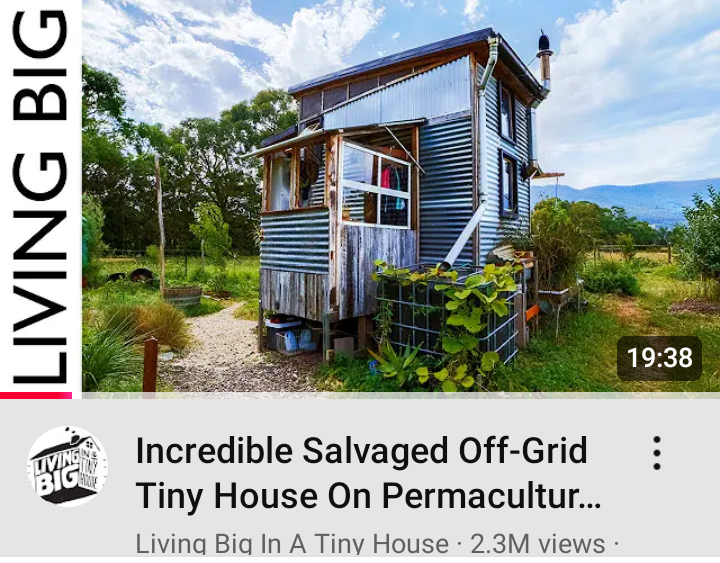
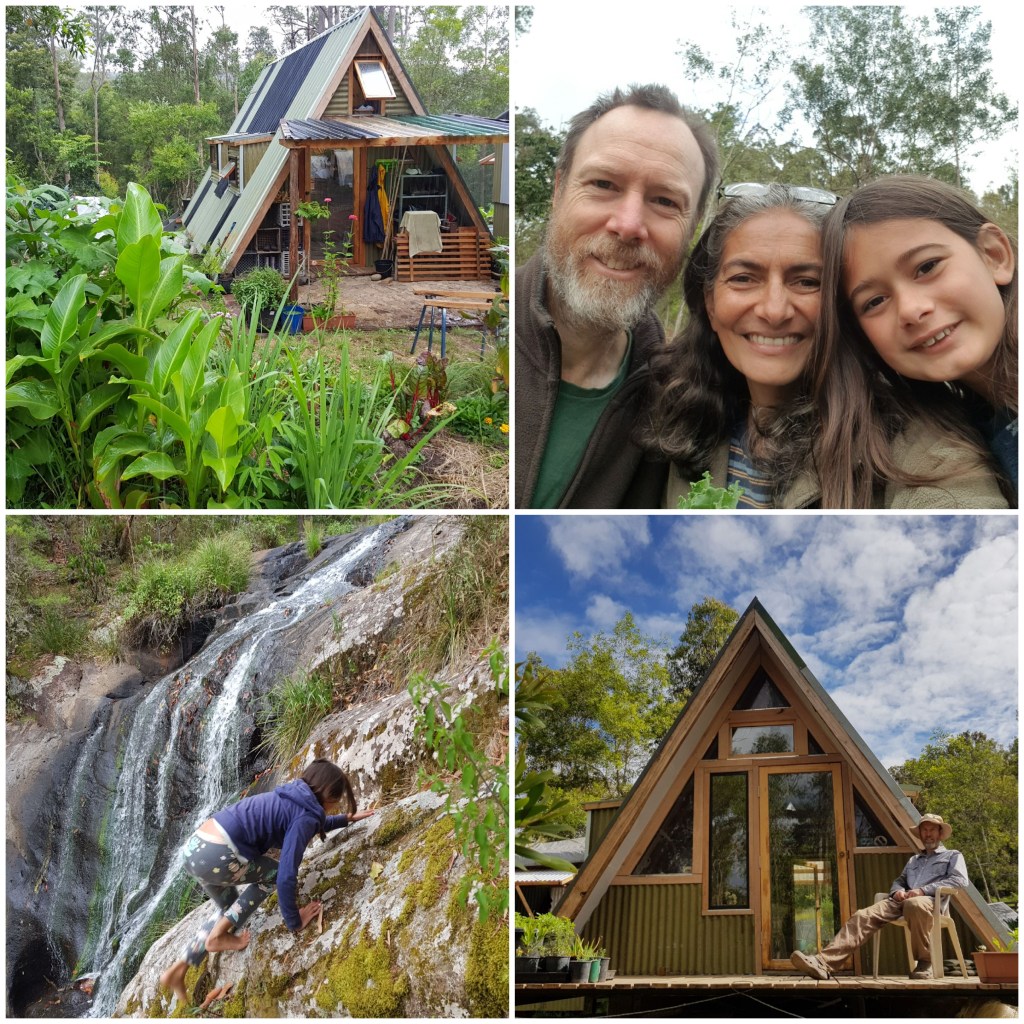
This is when we stumbled upon the concept of Tiny House living. This would enable us to circumnavigate certain building codes. With the council breathing down our necks, we had all the motivation we needed to get cracking on designing and building our own tiny house. We called it “The Tall Tiny”. We gleaned a lot of great ideas online from other tiny house builders and were so grateful for all of the inspiration that we decided to share our journey on a Facebook page. We also got to meet Bryce from the Youtube channel, “Living Big in a Tiny House” and he was keen to do an episode on our house. The video went online 7 years ago and has received 2.3 million views in that time. I mention this, not only to boast, but also because that video played a crucial role in having us find Bindarrabi, the community in which our block, “Headwaters Haven” is situated. In permaculture there is a principle that says, “the problem is the solution”. Looking back on how this chapter of our life unfolded I am reminded to always look for the opportunity in what might seem like a crisis. What is emerging from the emergency? What message is in the mess? What’s the silver lini……..OK, you get the point.
It was a combination of things that had us move on from this small community after 8 years living there. Originally it was the intention of the community collective to co-own the property, but council regulations and title laws made that very difficult. In the end, two of the three families left. We were very fortunate to receive back the money that we’d invested in the property, and this became our nest egg that enabled us to buy into Bindarrabi. We had previously entertained dreams of settling in Queensland further in the future but had wanted to stay in Victoria for the duration of Grace’s schooling because she was going to a Waldorf school which we valued immensely, having both previously completed the Waldorf teacher training. Then Covid came and after two years of lockdowns, on-screen-at-home-schooling, no idea of how much longer this would continue, and no place of our own, we decided to take a leap of faith and go in search of a new home in Queensland.
Because of border closures we were unable to get beyond the border into Queensland so we camped out at our friends’ property near Coffs Harbour. We were enjoying the location so much that we started exploring Northern New South Wales as an option. We decided to post on off-grid-living Facebook pages stating who we were and what we were looking for and how much we had to spend. We only got a handful of responses and nothing solid. It was then that we had the idea of including a link to the “Living Big in a Tiny House” video. It beautifully illustrated who we were and what we were about. Most importantly, it showed that we were people of action who were walking their talk when it came to alternative lifestyle choices. The response was overwhelming. It literally took us two days to respond to all of the messages and to sort out the true leads from the rest. Included in the messages was one from a resident of Bindarrabi. We arranged a visit and after a 3 day stay, we applied for membership. It was a quick decision but If you ever come and visit, you’ll understand why.
We are now coming up to our 4th year anniversary at Headwaters Haven and our intention with this blog is to share our adventures of “loving living a hand-made life” with you. We hope you join us for the ride and maybe come and visit us sometime.
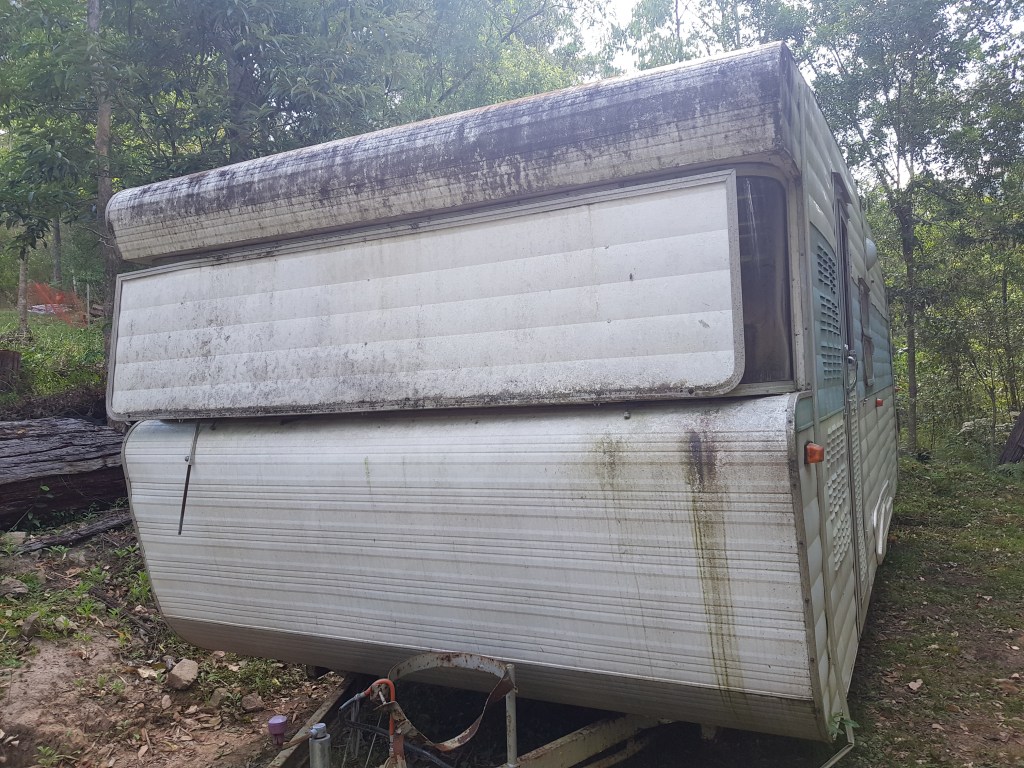
About 2 years ago we bought a caravan from a fellow community member. It had been a Reno project on hold for them but after a close shave with a grass fire that managed to melt the indicators, some of the perspex windows and the plastic wheel arch covers, they decided to move it on. As we were looking for a caravan to become our guest accomodation, we made an offer, they agreed and we became the proud new owners of a 6 meter long caravan. The great thing about buying it from a community member was that it was a short tow from their block to ours using the community tractor.
Before we moved it though, we needed a place to park it, so our neighbor Ben, excavated a pad with his excavator. It took about 6 hours from start to finish. “A bit quicker than digging it by hand”, he liked to remind me as he worked. I could only agree whole heatedly.
Once that was done, we ferried the enormous beast to it’s new home.
I intended to give it a fresh coat of paint, so started washing it. To my surprise, the powdery outer layer washed off to reveal quite a nice under layer, which was a definite improvement. Always keen to knock unnecessary jobs off the list, I decided it was job done.
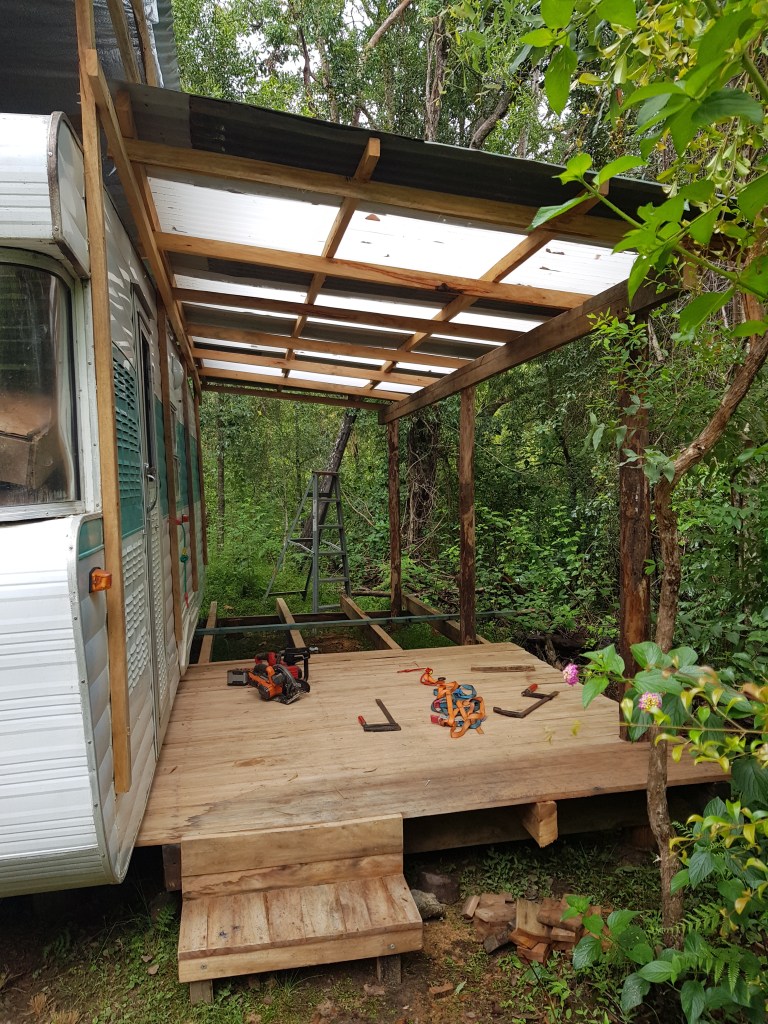
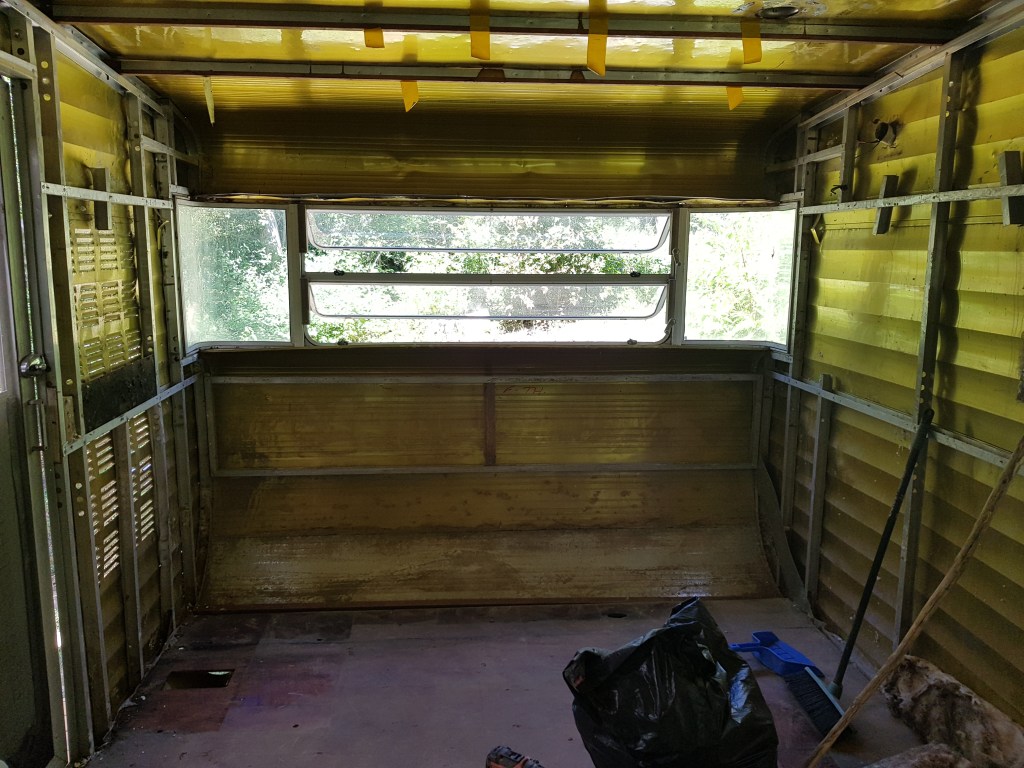
The interior contained some plywood panels, couch cushions and insulation that we’re worth salvaging but needed removal so that I could work on the interior. Besides that, I needed to weather proof the caravan, so I decided to build an exterior roof and additional awning to cover the deck that would run along the entire northern length. This would be where I could shelter materials and tools and also work in inclement weather.
I was grateful to be able to mill all of the timber I needed for decking and framing from trees that were previously felled for safety reasons, only meters away from the caravan site.
With the shelter up, I could now go to work on the interior. Years of having a leaky roof and a community of rats squating inside had taken its toll. It required gutting right down to, and including, the subflooring. What was salvageable was stored under the awning and the rest was taken to the tip. (The old subflooring has already come in use as the new cookhouse floor.) The absolute best thing going for this caravan was it’s aluminum skeleton. This meant that, despite it’s rundown appearance, it was absolutely ship shape in its structural integrity.
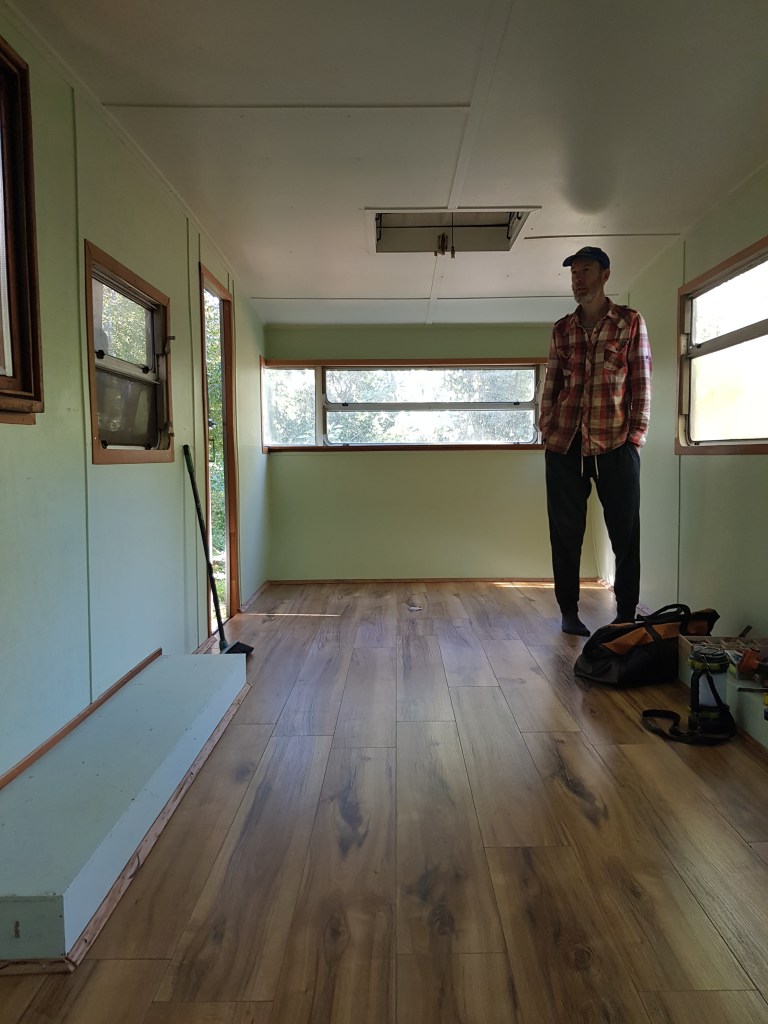
From this point, it was a matter of replacing the floor and then attaching plywood to walls and ceiling after sandwiching in the insulation. A little fun fact about the 2nd-hand plywood is that we bought it from a guy who’s job involved transporting explosives across the country for use in the mining industry. Regulations required that the explosives be contained in shipping containers lined internally with plywood fixed with copper nails. He had so much that he sold it in packs….the plywood, not the explosives.
The other priority was to seal the interior against further wildlife habitation. For this I needed to replace the large windows on the west end that had been damaged in the fire as well as the wheel arch covers that had likewise met their demise.
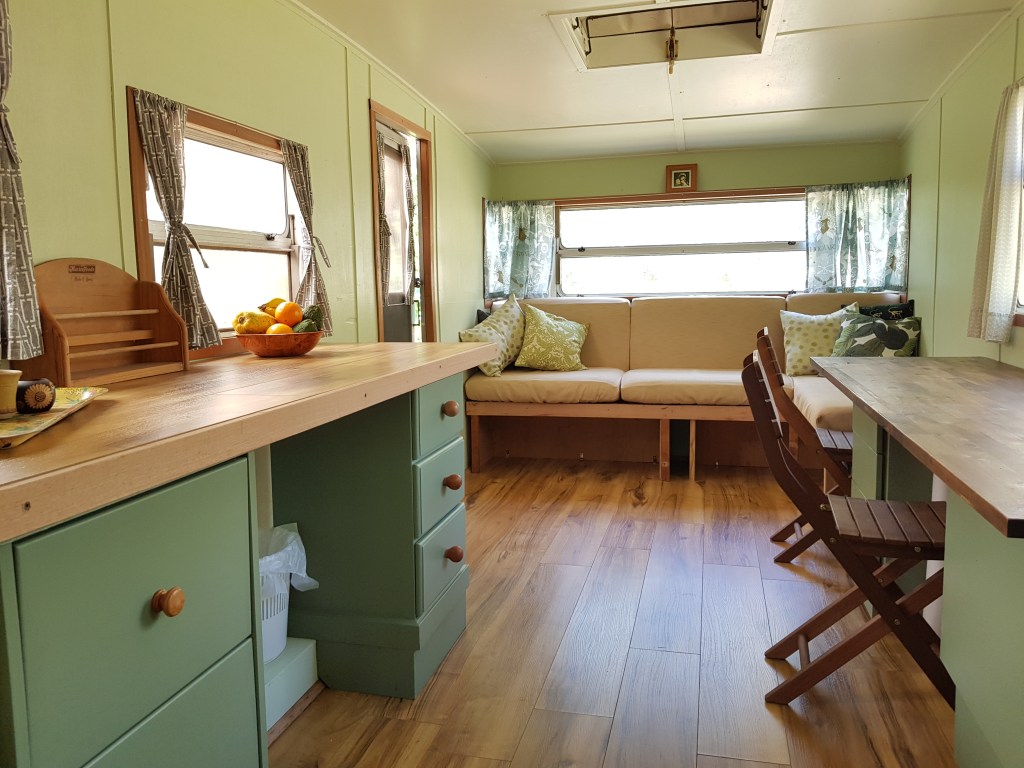
Once that was done, I installed trim around windows and doors and over the joins where sheets of ply butted up against each other. Vicky and I then painted the walls and ceiling after which I layed floating floor boards.
In all, it was a very big, but also a very satisfying process and the results were stunning, if I do say so myself.
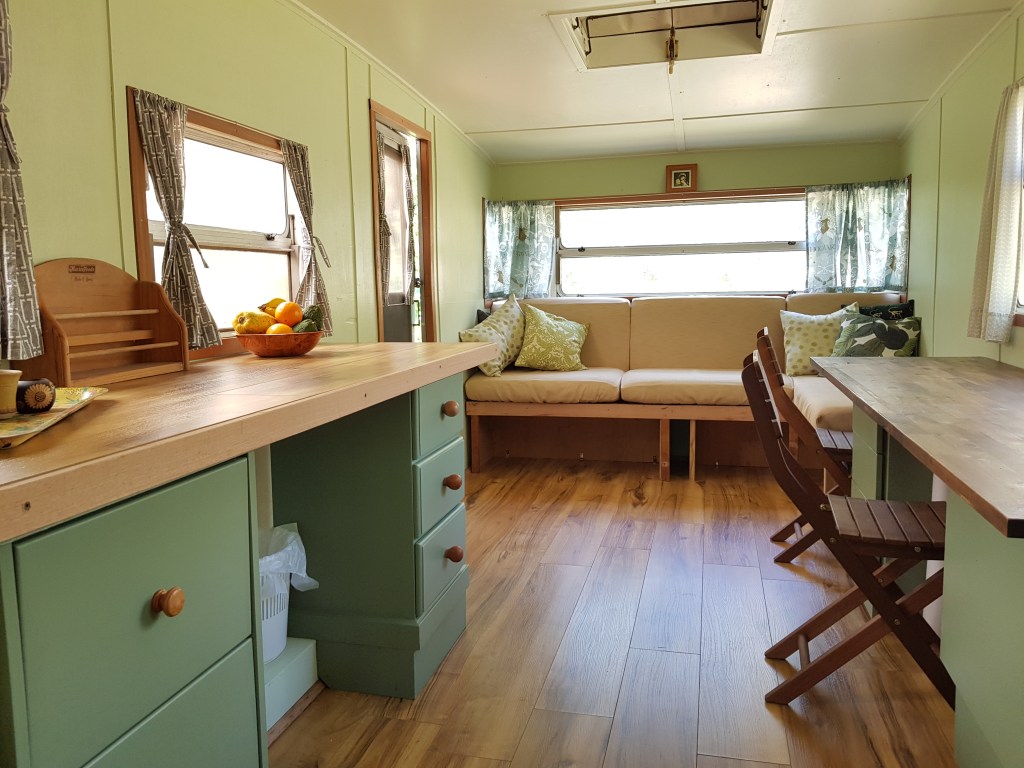
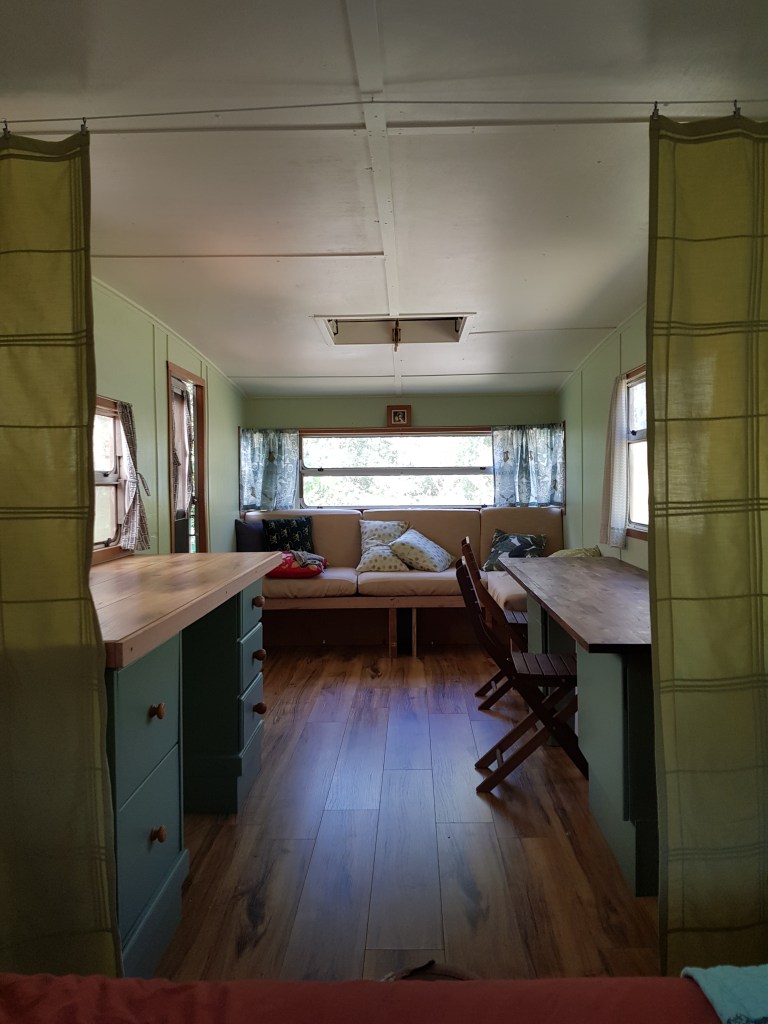
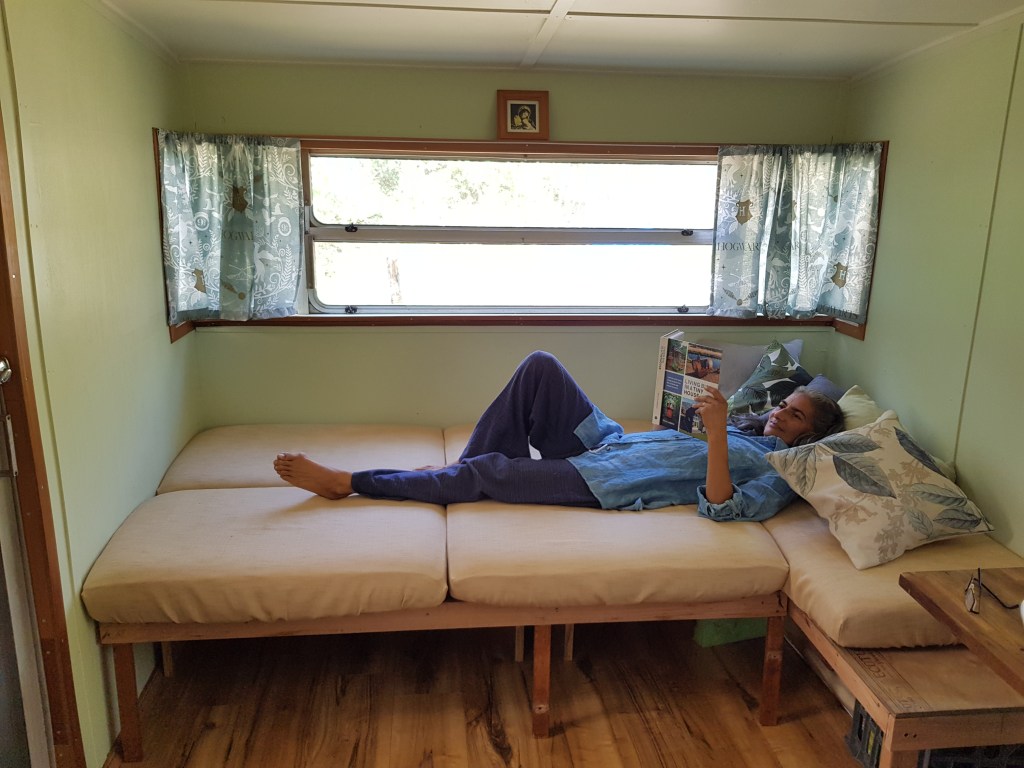
Vix and I sat down, before we had started any of the renovations, and desiged a floorplan. We worked within the limitations of the existing door and window configuration, with the exception that I added one window on the north side for greater natural light and warmth. Now with the inner lining complete, it was time to fill in the spaces. The design was simple: an L-shaped couch down at the eastern end to the left of the entrance, a queen size bed down the other end, a study bench along the southern wall and a kitchen bench along the north wall. A cool hack I’ve come to enjoy using for kitchens and offices is to grab a bunch of drawers to use as the foundations for a bench. I reconcile their height differences by making props to raise the base, paint them all the same colour and hey presto, you have a kitchen cabinet with bench top. We are yet to install the kitchen proper, which will be located outside on the deck.
One cool feature of the couch is that it extends out into a good sized bed that could sleep one adult or two kids. The office bench goes as far as the couch, which can serve as a dining table for two, one person sitting on the couch and the other on the office chair.
Our next step is to install a basic kitchen on the deck, a composting dunny nearby and some rainwater catchment for a water supply. We then plan to spend a couple of weekends staying in the caravan to get a sense of how it performs as a dwelling and what improvements it might need.
Finally after all that we’ll be ready to receive visitors, whether they be family, friends, volunteer helpers or paying guests. Having said that, we’re already loving having the extra space for Grace to have sleep-overs with friends, Vix to have a place where she can spread out her crafts to work on and me to sit back on the couch and admire the job I did on the west windows.
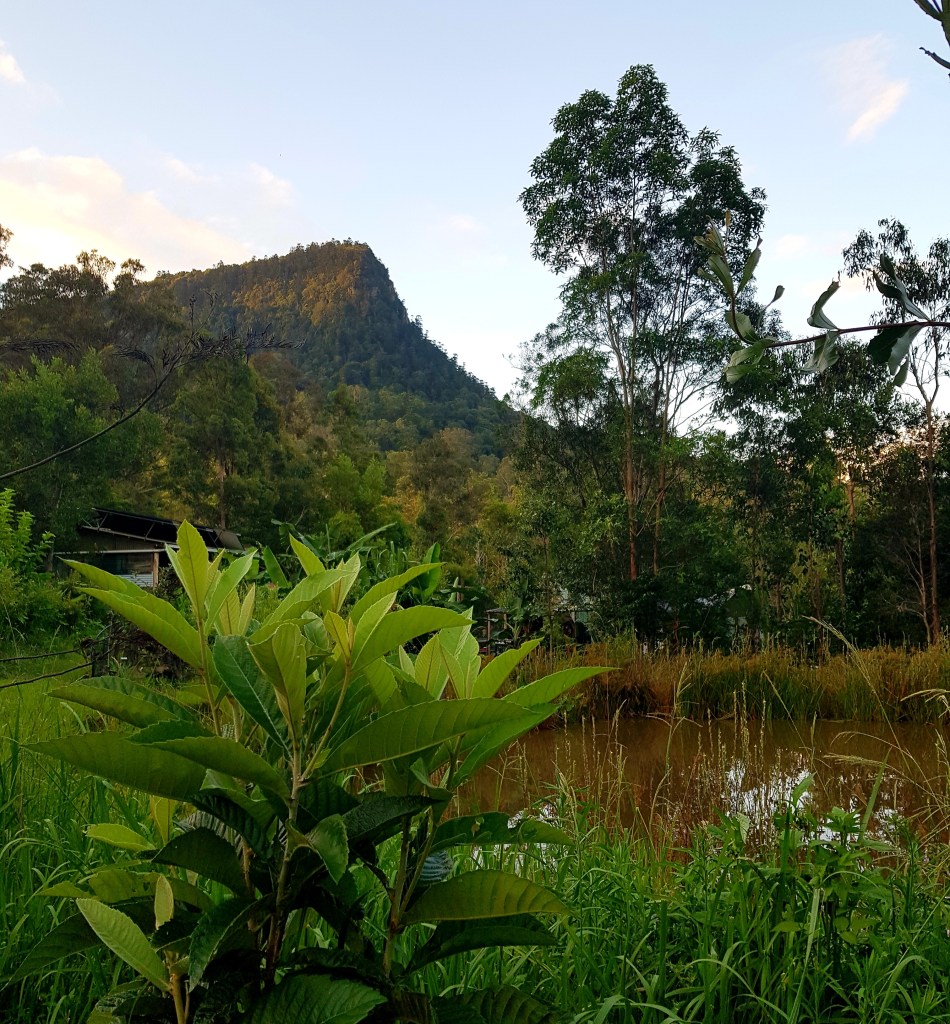
Headwaters Haven is the name we’ve chosen for our home block, 2 acres within Bindarrabi community in Koreelah, NSW, Australia.
The property is nestled in the Western end of the Border Ranges before it meets the Great Dividing Range. We are at the headwaters of the mighty Clarence river and this has inspired our name.
At Headwaters Haven we’re loving living a handmade life. We love permaculture, handcrafts, resilience and thrift, and hope to inspire others to explore and play with ways of living that celebrate creativity and working with what’s at hand.
We’ve been at our current site for about 4 years and have been busy building shelters, growing food, setting up food forests and developing infrastructure and systems like a plant nursery, a chook run a work shed and visitors accommodation.
We’re now ready to start offering learning opportunities and experiences to others and have plans to run
A Bush Craft Weekend with workshops on green wood work, food forest creation, yoga and textile handcrafts
A Permaculture Design Certificate course
Volunteer and visitor stays
Stay tuned for dates and leave us your details if you’re interested (victoriabasdeo66@gmail.com)








 Headwaters Haven